
The increasing cost of wastewater treatment, further exacerbated by tightening environmental norms, has set up a strong drive toward integrating nature based solutions into the existing treatment frameworks. Among these, phycoremediation, the use of algae to remove pollutants and sequester carbon stands out for its two fold benefits in pollutant removal and resource recovery.
Today, a trending concept named “Phycoremediation 2.0,” has surfaced where industrial and municipal wastewater treatments are being reconsidered. It involves retrofitting existing treatment systems such as MBR, MBBR, and SBR with algal systems for improved efficiency, sustainability, and cost effectiveness.
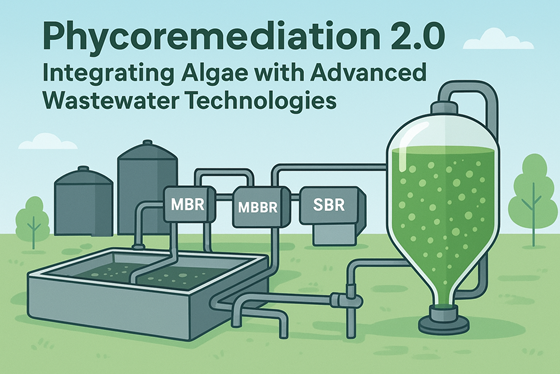
Over the past decade, communities and industries are choosing microalgae and cyanobacteria as nature based, energy efficient solutions that can be seamlessly added to traditional treatment processes. Driven by rising concerns over water scarcity, climate change, and the human health impacts of nutrient pollution, algal-based systems offer a practical upgrade that transforms wastewater into a valuable resource.
A. Integration of Algal Systems with MBR
The incorporation of algal systems with membrane bioreactors (MBRs) improves the efficiency of wastewater treatment by harnessing the advantages of each process. The MBR provides effective and high quality solid liquid separation and anaerobic biodegradation by the bacteria. Algae effectively provide additional polishing and anaerobic metabolic capacity.
In the post MBR polishing stage, algae uptake remaining nitrogen and phosphorus filtered through the membranes which greatly reduce nutrient loading into the final effluent. Algae also produce oxygen as they photosynthesize which can partially replace the mechanical aeration employed in traditional MBR treatment systems. Studies have shown that the integration of algal–bacterial processes can reduce the aeration energy demand by up to 30% [3]. In addition, the algal biomass produced in this stage can be harvested for value-added products such as biofertilizers or biofuels providing a sustainable approach.
Role of Algae in wastewater remediation:
Microalgae and cyanobacteria quickly take up remaining nutrients, mitigating eutrophication and enhancing effluent quality. At the same time, oxygen generated through their photosynthesis also reduces the power required for mechanical aeration—the most energy-intensive component of wastewater treatment. Research suggests that algal-bacterial systems can be successfully integrated into existing treatment strategies to decrease aeration energy consumption and increase nutrient removal efficiency, promoting environmental and economic sustainability [3].
It is important to highlight that microalgal biomass collected from these polishing organisms, is not waste, it is a resource. Microalgal biomass has high concentrations of proteins, lipids, vitamins and phytohormones. When converted to biofertilizer or biostimulant, it restores the flow of energy and nutrients back into agricultural systems, creating a circular economy between wastewater treatment and agriculture. An important facet of the circular bioeconomy approach can then convert urban and agricultural waste streams into sustainable inputs for crop production, supporting reduction of chemical fertilizer usage and regeneration of soil health [6].
As many regions continue to grapple with the scarcity of water and nutrients, integrating microalgae into wastewater treatment plants presents a human-centered solution that enhances food security, reduces environmental pollution, and allows urban agricultural communities to adopt greener and more cost-effective methods, without restructuring existing infrastructure.
B. Integration of Algae into MBBR Systems
According to recent studies on greywater treatment, MBBR systems can achieve some reduction in the organic load but do not consistently achieve satisfactory treatment levels for COD (chemical oxygen demand) and turbidity, nor are they effective in treating ammonia. These significant limitations have prompted the incorporation of an algal polishing unit downstream of the MBBR treatment, especially for systems primarily considering non-potable reuse. Algae–MBBR hybrid systems incorporate the algae downstream from the MBBR treatment, while the bacteria biofilms on the moving carriers treat the incoming organic load. The algae will treat leftover pollutants from the MBBR that are not treated effectively [5].
How algae work in MBBR system:
Algae can contribute in improving effluent quality to meet reuse standards by taking up residual nitrogen and phosphorous nutrients as their removal is difficult for both membrane bioreactor (MBR) and moving bed biofilm reactor (MBBR) systems. Algae enhance effluent quality because, through photosynthesis, they naturally produce oxygen into the systems which can supplement the aeration produced by the MBBR biofilm and reduce energy use associated with mechanical aeration. Algae also help to mitigate low turbidity by taking up fine suspended solids, which can facilitate the natural floc formation, which can stabilize effluent quality in situations where MBBR reactors alone vary in effluent quality. Additionally, algal biomass growth adds a new resource recovery opportunity, since harvested biomass can be used for biofertilizer or other value-added applications, which reinforces the circularity of the treatment process. [6]
Overall, coupling algae with MBBR addresses key nutrient and turbidity limitations identified in recent greywater studies and enhances system sustainability, making hybrid systems more fit for decentralized and reuse oriented wastewater treatment.
C. Integration with Sequencing Batch Reactors (SBR)
For years, sequencing batch reactors (SBRs) have been recognized and utilized in wastewater treatment for their versatility, ability to control reaction stages, and capacity to treat varying loads. Much like other biological treatment processes, SBRs can have limitations in complete nitrogen and phosphorus removal, and especially under variable greywater or municipal wastewater conditions. Recently, the integration of algae to improve SBR performance has emerged as a promising opportunity to enhance the hybrid algae-SBR configurations for better nutrient polishing and effluent stability [4]. In these hybrid configurations, the SBR microbial community first degrades organic matter and performs nitrification, and then algae is added to a separate photobioreactor or through an illuminated phase utilizes the untreated residual nitrogen and phosphorus.
How algae work in SBR systems:
Algae directly uptake ammonium, nitrate, and phosphate as biomass, which allows for nutrient removal to occur naturally without the need for additional chemicals. It also contributes to the oxygenation of mixed liquor through photosynthesis, which can supplement or partially replace aeration during the aerobic phases of the SBR process, greatly decreasing energy input, specifically during long aeration periods. (Alomar, O et al., 2024) Algae are involved in bioflocculation, where algal-bacterial aggregates can improve settling and turbidity removal during the SBR settling stage. CO₂ produced by bacteria during respiration is taken up by algae and provide a synergistic relationship that improves reactor stability. Algal biomass can also be harvested and used as bioresource enhancing circular economy [4]
Combined, these concepts make algae assisted SBR’s a compelling advancement of traditional batch treatment technology as they provide more nutrient removal, improved energy efficiencies and even more resource recovery all within the framework of modern sustainable wastewater management.
Benefits to EPCs and Customers
For EPCs (Engineering, Procurement, and Construction Firms:
-
- Value addition without major design changes: Retrofitting an algal module requires minimal structural modification. This enhances the sustainability profile of projects, thereby helping EPCs achieve green building or ESG compliance goals.
-
- Competitive Differentiation: “bio augmented” STPs and ETPs cum factories positions EPCs as technology forward and helps to win the bids for smart city or industrial zone tenders.
-
- Reduced Operational Energy Load: The integration of algae reduces aeration and chemical dosing costs, directly improving plant ROI and lifecycle efficiency
For Customers (Industries, Municipalities, Developers):
-
- Operation Costs Saving: The studies from the pilot sites in India established that AgroMorph, 2024 can reduce aeration energy by up to 40% and cut sludge handling costs by 25–30% after the integration of algae.
-
- Circular Resource Recovery: The algal biomass can be converted into bio fertilizer, animal feed, or biogas substrate to make new streams of revenue.
-
- Regulatory Compliance and Branding: The reduction in nutrient discharge will help meet the CPCB discharge norms and enhance the customer’s sustainability credentials, especially for sectors like pharma, dairy, and textiles.
Emission Reduction Potential
The application of algae in biological wastewater treatment systems provides enhanced nutrient polishing and a viable pathway for greenhouse gas mitigation. The photosynthetic action of microalgae directly results in atmospheric carbon capture as the treatment process inherently sequesters carbon in the biological carbon sink. Approximately 1.83 kg of CO₂ are fixed into cellular carbon for every 1 kg of produced algal biomass [2]. The potential for carbon capture is particularly relevant when algae is integrated into existing bioreactors like MBR, MBBR, SBR, or AnMBR, where high rates of microbial respiration will naturally produce CO₂ as a result of organic matter breakdown.
Establishment of a tightly coupled carbon loop using algae:
CO2 released from microbial respiration is immediately utilized by the algae as a carbon source, reducing the amount of CO2 that would otherwise escape into the atmosphere. This internal recycling of carbon not only supports robust algal growth but also offsets emissions that are inherent to biological treatment processes. Depending on hydraulic retention time, algal density, and light availability, such integrated systems can reduce overall treatment related carbon emissions by 15–25%, making them a powerful supplement to conventional low carbon wastewater strategies. [7]
Additionally, oxygen generation during photosynthesis reduces the demand for mechanical aeration, which is one of the most energy-intensive aspects of aerobic wastewater treatment. This benefit lowers aeration demand, which in turn reduces electricity usage and lowers Scope 2 (energy-related) emissions. In energy-intensive systems such as membrane bioreactors (MBRs) or sequencing batch reactors (SBRs), changing the aeration demand can greatly affect operational sustainability, especially in systems where aeration accounts for 40-60% of total energy consumption [8].
At larger scales, these benefits are advantageous and impactful. When considering urban sewage treatment plants (STPs), even partial phycoremediation retrofits can provide the opportunity to avoid emissions of 0.2-0.3 tonnes of CO₂ for every million litres per day (MLD) of wastewater treated. As cities are beginning to plan for infrastructure with a net carbon focus, this opportunity of carbon emissions avoidance becomes quite valuable, especially for STPs that operate under a net zero or carbon neutral pledge. As well, algae systems that capture process generated CO₂, decrease the demand for energy through aeration, and take waste nutrients and convert them to usable biomass, offer another multi-faceted pathway to achieve greenhouse gas emission reductions, resource recovery, and enhanced environmental performance [7].
Conclusion
The transition towards sustainable wastewater treatment increasingly requires solutions that are technologically sound, yet ecologically regenerative and economically viable. Phycoremediation 2.0-integrating algae into established systems such as MBR, MBBR, SBR, and even advanced configurations like AnMBR-stands out as an important step in this regard. Instead of displacing existing infrastructure, algal retrofits enhance and extend the capacity of conventional biological reactors through natural nutrient polishing, internal carbon recycling, and photosynthetically driven oxygenation.
These benefits range across all hybrid configurations: improved nitrogen and phosphorus removal, energy demand reduction for aeration, enhanced clarity of effluent, and production of high-value algal biomass for circular bioeconomy purposes. Wastewater remediation conducted at various streams, ranging from greywater and municipal sewage to industrial effluents, show that algae have the potential to fill the gaps in nutrient removal unachievable by conventional systems, especially when considering decentralized or reuse-oriented treatment.
Beyond pollutant removal, the climate benefits are equally compelling. By fixing approximately 1.83 kg of CO2 per kilogram of biomass, algae transform bioreactors into micro-carbon sinks, reducing emissions from both biological respiration and electricity consumption. Scaled across urban STPs, these integrated systems can achieve CO2 offsets of 0.2–0.3 tonnes per MLD-an impactful contribution to municipal carbon neutrality goals. This dual role in treatment and decarbonization positions algae among the most promising nature-based technologies for modern wastewater management.
With algae-enabled systems offering EPCs quick integration, competitive differentiation, and measurable ESG gains without major structural overhauls, the benefits for client industries, municipalities, and developers are all about saving on their operational costs, enhancing their regulatory compliance, while also opening up new revenue streams from biomass-derived products.
Overall, phycoremediation retrofits shift wastewater management from a linear, energy-intensive model to a circular, self-sustaining one. By merging engineered bioreactors with the metabolic versatility of algae, wastewater becomes not just something to dispose of but a resource to recover, a bio-product to generate, and a climate solution to scale. As water scarcity, energy costs, and environmental standards continue to intensify, algae-integrated systems offer a practical, future-ready pathway for greener, more resilient wastewater treatment around the world.
Reference
- Dong, G., Chen, B., Liu, B., Hounjet, L. J., Cao, Y., Stoyanov, S. R., … & Zhang, B. (2022). Advanced oxidation processes in microreactors for water and wastewater treatment: Development, challenges, and opportunities. Water Research, 211, 118047. https://doi.org/10.1016/j.watres.2022.118047
- Wang, G., Liu, G., Yao, G., Fu, P., Sun, C., Li, Y., … & Chen, R. (2023). Biochar assisted anaerobic membrane bioreactor towards high efficient energy recovery from swine wastewater: performances and the potential mechanisms. Bioresource Technology, 369, 128480. https://doi.org/10.1016/j.biortech.2022.128480
- Abudaqqa, W. S., Madhuranthakam, C. M. R., & Chaalal, O. (2024). Algae based membrane bioreactors: a mini review on their progress and processes for wastewater treatment. Journal of Water Process Engineering, 59, 104937. https://doi.org/10.1016/j.jwpe.2024.104937
- Alomar, O., ElMekkawy, T. Y., & AlMomani, F. A. (2025). The performance of integrating solar biomass energy in wastewater treatment plants (WWTPs): A review paper. Cleaner Waste Systems, 100422. https://doi.org/10.1016/j.clwas.2025.100422
- Ribarova, I., Vasilaki, V., & Katsou, E. (2024). Review of linear and circular approaches to on site domestic wastewater treatment: Analysis of research achievements, trends and distance to target. Journal of Environmental Management, 367, 121951 https://doi.org/10.1016/j.jenvman.2024.121951.
- Ronga, D., Biazzi, E., Parati, K., Carminati, D., Carminati, E., & Tava, A. (2019). Microalgal biostimulants and biofertilisers in crop productions. Agronomy, 9(4), 192. https://doi.org/10.3390/agronomy9040192
- Kong, W., Kong, J., Feng, S., Yang, T., Xu, L., Shen, B., … & Lyu, H. (2024). Cultivation of microalgae–bacteria consortium by waste gas–waste water to achieve CO2 fixation, wastewater purification and bioproducts production. Biotechnology for biofuels and bioproducts, 17(1), 26. https://doi.org/10.1186/s13068-023-02409-w
- Liberti, D., Pinheiro, F., Simões, B., Varela, J., & Barreira, L. (2024). Beyond bioremediation: the untapped potential of microalgae in wastewater treatment. Water, 16(19), 2710. https://doi.org/10.3390/w16192710